
The Truth About Mulch (It's More Important Than You Think)
Mulch isn't just decoration. It's one of the hardest-working things you can put in your yard, and most people apply it wrong.
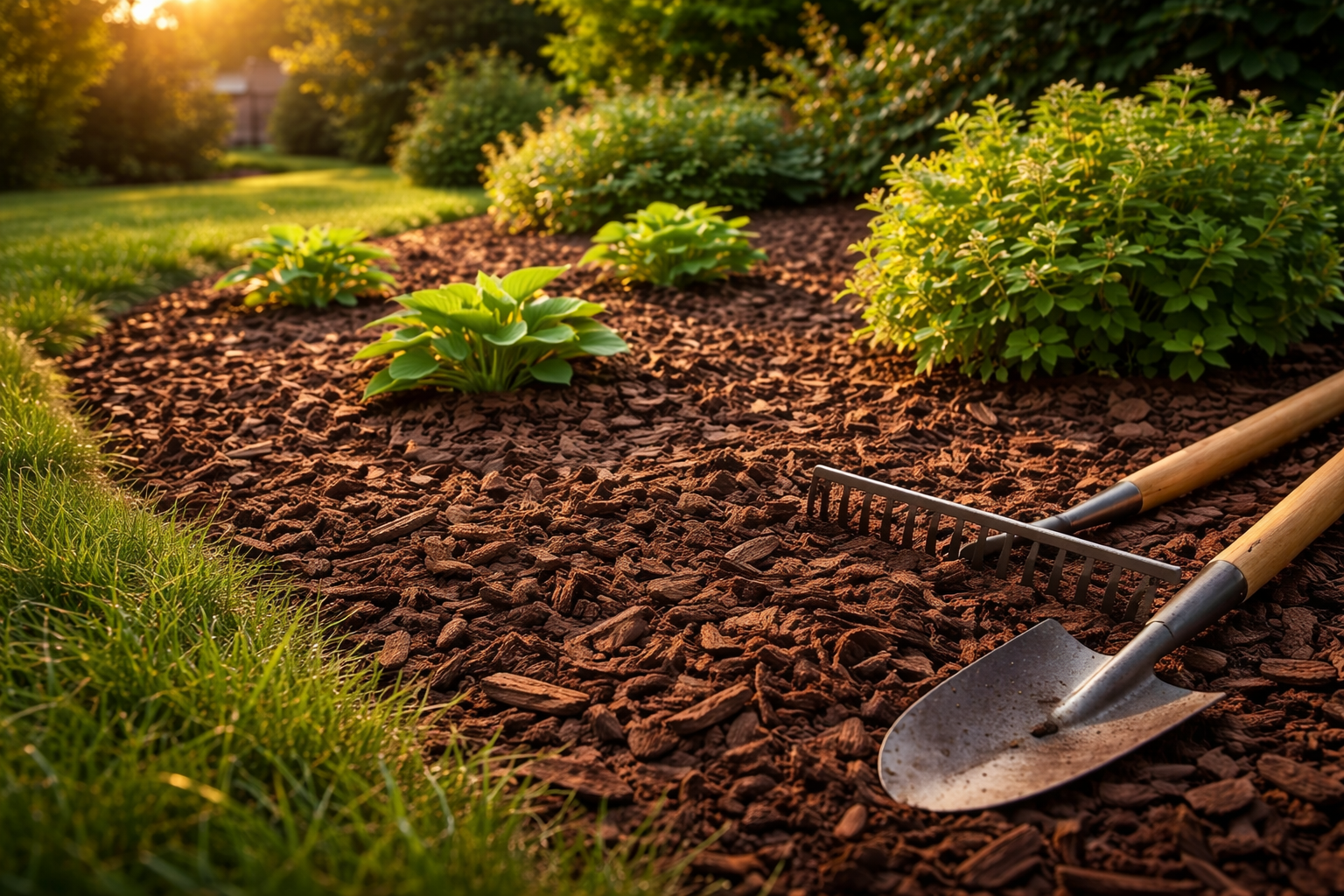
I used to think mulch was purely cosmetic. You put down the dark stuff, your beds looked tidy, homeowner mission accomplished. Then I learned what mulch actually does and I started taking it a lot more seriously.
What Mulch Actually Does
The short version: mulch is doing real work in your yard even when you’re ignoring it.
A proper 2–3 inch layer reduces soil water evaporation by 50–70%. That’s not a rounding error — it means you can water less and your plants stay healthier through dry stretches. In summer, that same layer keeps soil temperature 8–12°F cooler than bare ground, which protects root systems from heat stress. In winter, it works the other way — keeping soil 7–10°F warmer, which prevents roots from freeze-thaw heaving cycles that damage perennials over time.
On weeds: a 3-inch layer of wood chip mulch blocks up to 90% of weed seeds from germinating. Drop below 2 inches and that effectiveness falls off by nearly half — depth is the key variable, more so than which type you use.
On top of all that, organic mulch breaks down over time and feeds the soil biology underneath it. Worms, fungi, and microorganisms use it as food, which builds soil structure and fertility without you doing anything. That’s a lot of work for something you install once a year.
The 2–3 Inch Rule
Two inches is the minimum for effective weed suppression and moisture retention. Three inches is the target for most beds. Beyond four inches and you start causing problems — roots get starved of oxygen, soil goes anaerobic, and you create habitat for rodents and insects.
For coverage math: one cubic yard covers 100 square feet at 3 inches deep, or about 160 square feet at 2 inches. Measure your beds before you buy — it’s easy to underestimate.
Volcano Mulching Will Slowly Kill Your Trees
Drive through any suburb and you’ll see it: mulch piled up against tree trunks in a cone shape. Sometimes 6, 8, even 12 inches deep against the bark. It looks intentional. It’s one of the most common landscaping mistakes in residential yards.
Here’s what happens. Constant moisture trapped against bark causes rot that works inward toward the cambium layer — the vascular tissue that moves water and nutrients between roots and leaves. Once the cambium is damaged all the way around (girdled), the tree dies. Slowly, over 3–10 years, in a way that’s easy to miss until it’s too late.
On top of that, trees sometimes try to root into the mulch pile rather than outward into soil, creating girdling roots that circle the trunk and eventually strangle it. University of Minnesota research found over 80% of trees with severe girdling roots showed significant decline within ten years.
The fix is simple: pull mulch back 3–6 inches from the trunk. Leave the root flare exposed and visible. Mulch rings should be flat and wide, not deep and volcanic.
Which Type to Use
Not all mulch is the same, and some options are worth avoiding.
Shredded hardwood bark is the workhorse for most beds. It looks clean, stays put reasonably well, and breaks down into decent organic matter. This is what’s in most bagged mulch. Works well for flower beds and general landscaping.
Arborist wood chips are fresh-chipped whole-tree material — the stuff tree services haul away. They’re coarser and less uniform than processed mulch, but they feed soil biology more aggressively because they include bark, branch wood, leaves, and green material together. A website called ChipDrop (getchipdrop.com) lets you request a free load from local tree services. The tradeoff: you take what they bring, and it can be 10+ cubic yards in your driveway at once. Best around trees, shrubs, and large planting areas.
Cedar mulch does contain natural oils that repel certain insects — USDA research found it repels black-legged tick nymphs and deters some ants and cockroaches. What it doesn’t repel: slugs, snails, earwigs, or most beetles. And the effect fades as the oils weather and volatilize, so old cedar mulch has little insect-repelling benefit. Worth using near patios; not a magic barrier.
Pine straw is common in the Southeast and works fine. One persistent myth worth killing: pine needles do not meaningfully acidify soil. Multiple university extension programs have confirmed this. The acidity neutralizes during decomposition. If you actually need to lower your soil pH, use elemental sulfur — pine straw won’t do it.
Rubber mulch is made from recycled tires. It never decomposes, never needs replacing for bulk, and never feeds your soil. It also contains benzene, styrene, PAHs, and heavy metals from the tire rubber. Skip it in vegetable gardens and anywhere near food plants. It’s a permanent decision — once it’s mixed into a bed, you can’t realistically get it out.
Cocoa hull mulch smells like chocolate and looks great — but it contains theobromine, the same compound in chocolate that’s toxic to dogs. The concentration can be high enough to cause serious harm even in medium-sized dogs. If you have a dog, avoid it entirely.
Dyed mulch: the dyes (iron oxide, carbon black) are safe. The real concern is the wood source — colored mulch manufacturers sometimes use construction and demolition debris that may contain old CCA-treated lumber (arsenic and chromium). Look for the MSC (Mulch and Soil Council) certification on the bag.
Common Mistakes Beyond the Volcano
Mulching too close to the house. Keep at least 12–18 inches of clearance between mulch and your foundation. Mulch against a foundation creates moisture and a potential termite bridge. Gravel or stone works better right against the house.
Adding fresh wood chips to sensitive beds. Fresh, uncomposted wood chips have an extremely high carbon-to-nitrogen ratio. Soil microbes decomposing the wood temporarily pull nitrogen from the surrounding soil — called nitrogen drawdown — which can starve plants. Let chips age at least 6 months before using them in flower beds, or stick with processed bark mulch.
Sour mulch. When mulch is piled and stored without airflow, it can go anaerobic and produce acetic acid. Spread sour mulch (it smells like vinegar or sulfur) on active plants and you can kill them within days. If your mulch smells off, spread it thin, water it, and let it air out for a few days before using.
Piling new on top of old without checking depth. Most beds only need about an inch of new material each year to maintain the right depth. If you add a fresh 3-inch layer every spring without removing some of the old, you’re at 6+ inches after two years and doing more harm than good.
When to Mulch and How Often to Refresh
Spring is the primary window — after the soil has warmed but before weed seeds germinate in earnest. Mulching too early in spring insulates cold soil and delays warming, which slows plant growth. Late April to mid-May is the target for most of the country.
Fall mulching (October through early November) is about insulation, not weeds — protecting perennials and shrubs from freeze-thaw cycles before the ground freezes.
For refreshing: you generally don’t need to pull out old mulch. It’s decomposing and feeding your soil — that’s the point. Rake it loose if it’s compacted or has formed a water-repelling crust, then top-dress with an inch of new material. Only remove it if it’s diseased, infested, or your cumulative depth is already at 4+ inches.
Bagged vs. Bulk
Bags are convenient but expensive — you’re paying roughly $40–$110 per cubic yard when you calculate it out. Bulk mulch runs $15–$55 per cubic yard from a landscape supplier, with delivery usually breaking even at about 3 cubic yards. For anything more than a couple of small beds, bulk saves meaningful money.
One free option worth knowing about: fire pit ash in small amounts can be worked into garden soil or compost as a mineral amendment — potassium-rich and useful in acidic beds. If you have a backyard fire pit, those ashes don’t need to go in the trash. Mix them lightly into the soil around ornamentals, not directly on top as mulch.
The One Thing Nobody Tells You: Artillery Fungus
Wood chip mulch — especially coarser varieties stored in piles — can host a fungus that shoots spore masses up to 18 feet into the air, toward light sources. The spores hit your white siding, car, or windows and stick like tar dots that are nearly impossible to remove. Penn State research found that mixing about 40% used mushroom compost into landscape mulch greatly suppresses it. If your house or cars are close to your mulch beds and you’re using wood chips, this is worth knowing before you see it.
Mulch right and it pays you back every season — less watering, fewer weeds, healthier plants, better soil. It’s one of the highest-return things you can do in a yard for the time and money it takes.

Written by
Chris Bysocki
Dad of two (a 6-year-old daughter and a 3-year-old son), homeowner, and guy who learns most things the hard way. Writing about parenting, tools, yard work, and gear from a neighborhood in the real world.
More in this category

Ask Chris
Got a question about this topic — or anything dad-related? Send it over. I read every one.